
How it works
How CaseCenta helps manage
a workplace investigation.
Explore a guided workflow for organising the investigation. The prompts support your process; you remain responsible for the decisions.
A business owner’s walkthrough / HW-01
A workplace complaint example
for a small business.
Follow Morgan at fictional Harbour Workshop. This fictional example shows how to organise a concern, recognise when help is needed and keep the record together. It is a walkthrough, not a complete investigation procedure.
01ComplaintRecord what was raised, without deciding it.
Alex tells Morgan, the owner of Harbour Workshop, that Jordan removed a Saturday shift after Alex raised a concern. Morgan has eight staff and no HR team.
Keep in view: Alex’s account is an allegation. The reason for the roster change is untested.
Your next step: Morgan records dates, the words used and immediate support needs. Serious or urgent concerns need appropriate specialist help.
02PeopleGive each person a clear role.
Morgan records Alex as the person raising the concern, Jordan as the person responding and Sam as a potential witness.
Keep in view: Sam may have seen the roster change; that does not mean Sam knows the reason.
Your next step: Keep access limited. Record who needs to be interviewed and what they may know.
03Investigator & independenceRecognise when you should bring in help.
Morgan approved staffing budgets and may be a witness. Morgan therefore seeks a suitably qualified external investigator. The complaint and participant notes already recorded provide a starting point for the handover.
Keep in view: A recorded declaration does not establish independence.
Your next step: Check the investigator’s experience and possible conflicts, then agree the scope. Keep the existing case notes together for the handover.
04Evidence & interviewsConnect each account to what can be checked.
The appointed investigator reviews two roster versions, asks Jordan about the change and interviews Alex and Sam separately.
Keep in view: Jordan says the change reflected availability. Sam recalls a change but cannot explain why.
Your next step: Preserve originals, confirm interview notes and keep competing explanations visible. The accounts are not votes.
05Procedural fairnessMake room for a meaningful response.
Before any finding, the investigator identifies disputed information, records what has been put to the relevant people and tracks responses and outstanding questions.
Keep in view: A ticked task is not proof of a fair process.
Your next step: Seek advice on what needs to be shared, timing and the opportunity to respond. Consider the responses before reaching conclusions.
06Findings & reportMake the reasoning traceable.
The example report separates the recorded roster change from the disputed reason. The investigator identifies supporting material, conflicting accounts and limitations.
Keep in view: Illustrative outcome: the reason remains unresolved on the material shown. No disciplinary recommendation is generated.
Your next step: A person checks source references and reasoning. The authorised decision-maker considers next steps; the software does not decide the employment outcome.
How it works
Five stages of the
investigation workflow.
Explore the five stages below. This walkthrough explains the intended workflow using the current local product; it doesn’t start a live investigation.
Start with clarity
Record the complaint, define the scope and identify the people involved. Give the matter a clear starting point.
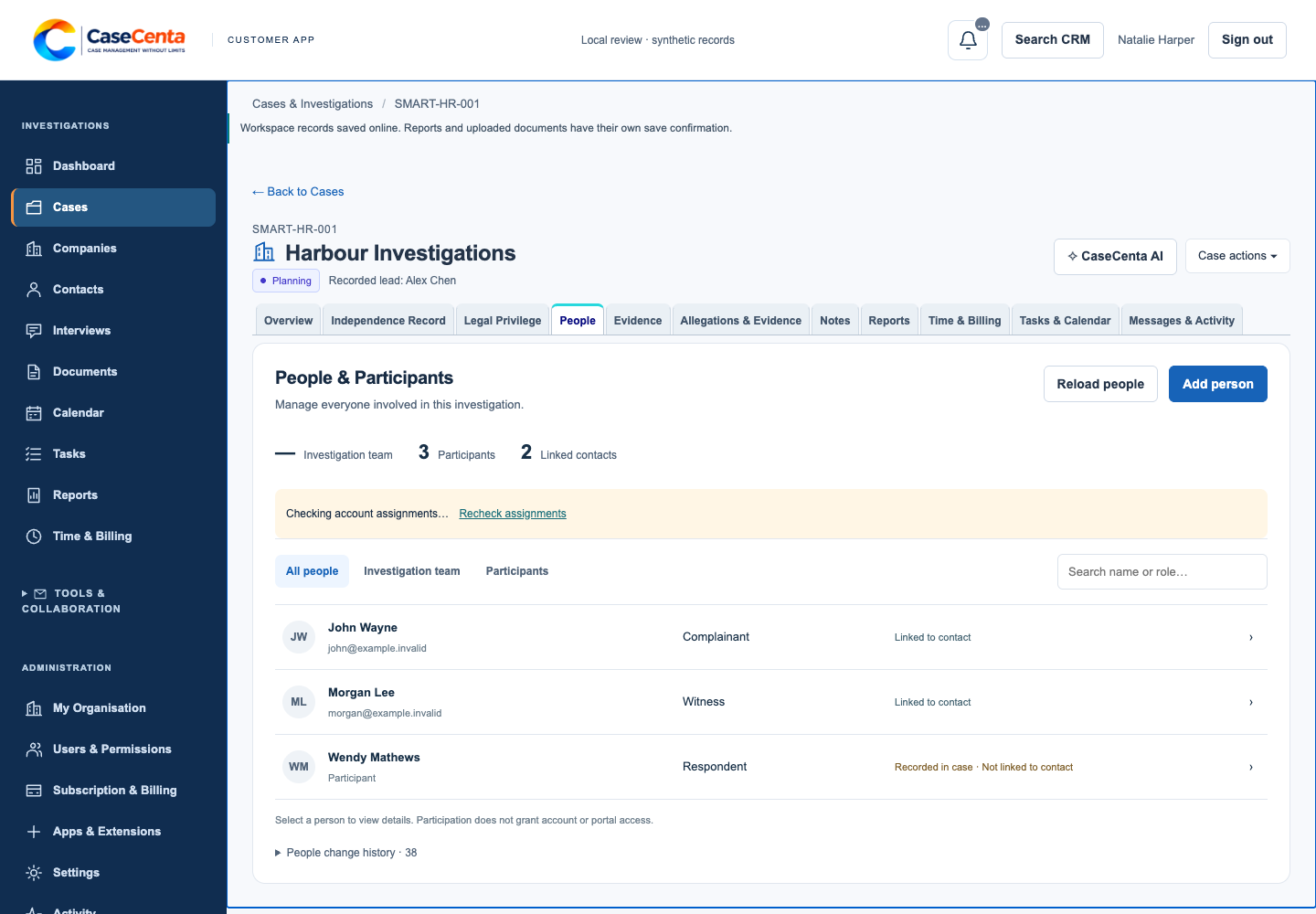
Product preview · fictional case and people. Screens show the development build.
What you bring to each stage
What to review at each investigation stage.
- 01 / Complaint & scope
Start with clarity
Record the complaint, define the scope and identify the people involved. Give the matter a clear starting point.
Before moving on: Confirm what is being raised, what remains unclear and whether urgent support or specialist advice is needed.
- 02 / Plan & assign
Plan the next step
Set up tasks, responsibilities and appointments. Keep the work moving with a visible investigation timeline.
Before moving on: Check responsibilities, possible conflicts and the scope of the work with the appropriate decision-maker.
- 03 / Evidence & interviews
Bring the facts together
Keep documents, interview records and allegations connected to the case. Spend less time hunting through scattered folders.
Before moving on: Identify missing records or unresolved questions. Keep allegations distinct from established facts.
- 04 / Review & fairness
Make room for a response
Track outstanding work and record responses before drawing conclusions. Prompts support your process; professional judgement remains yours.
Before moving on: Review the record of responses and outstanding work. Seek advice about the process appropriate to the circumstances.
- 05 / Findings & report
Build a considered report
Bring the case record into a structured report for review. Check the evidence, reasoning and conclusions before finalising.
Before moving on: Check the source material, reasoning and conclusions. Review every draft before deciding what may be shared.
General organisational workflow, not legal advice or a guarantee of procedural fairness.